Feeding Wild Hyenas

Home · Best Travel Experiences · Ethiopia
Harar, Ethiopia — 2013

The hyena closed its jaws beside my ear.

I wasn't frightened.

It was more like: wow.

I could feel its breath against me. I could smell it. I heard the jaws close and suddenly understood how little distance there was between my face and a large wild animal.

A few seconds earlier, everything had seemed under control.

Now the hyena was almost touching me.

Story Notes

Where
Harar, eastern Ethiopia — a walled Muslim city of narrow streets, mosques and shrines
When
2013 · about two weeks into an Ethiopia journey
The practice
Harar's hyena men have fed wild spotted hyenas at the edge of the city for generations
What locals told me
Stories connect the hyenas with djinn, protection and the balance between the city and the animals

The woman at my guesthouse told me to go

I had already been travelling around Ethiopia for about two weeks when I reached Harar.

The woman running the guesthouse where I was staying told me about the hyenas.

If I wanted to see something unusual in Harar, she said, I should go out in the evening and meet one of the men who fed them.

So I went.

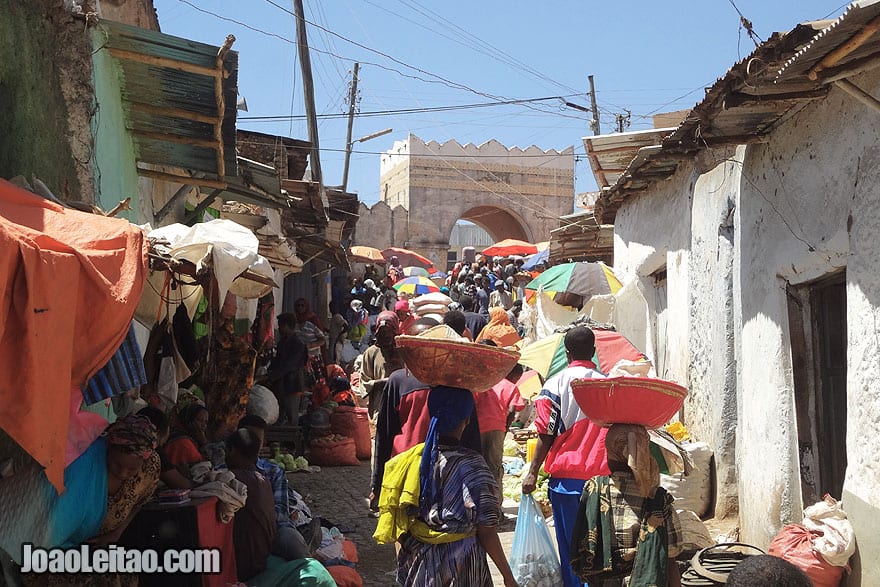
Harar already felt very different from the other places I had visited in Ethiopia. It is an old Muslim city in the east of the country, surrounded by walls and packed with narrow streets, houses, mosques and shrines.

But after dark, another part of Harar comes alive.

The hyenas come.

Waiting in the darkness

We went out after sunset.

There was very little light.

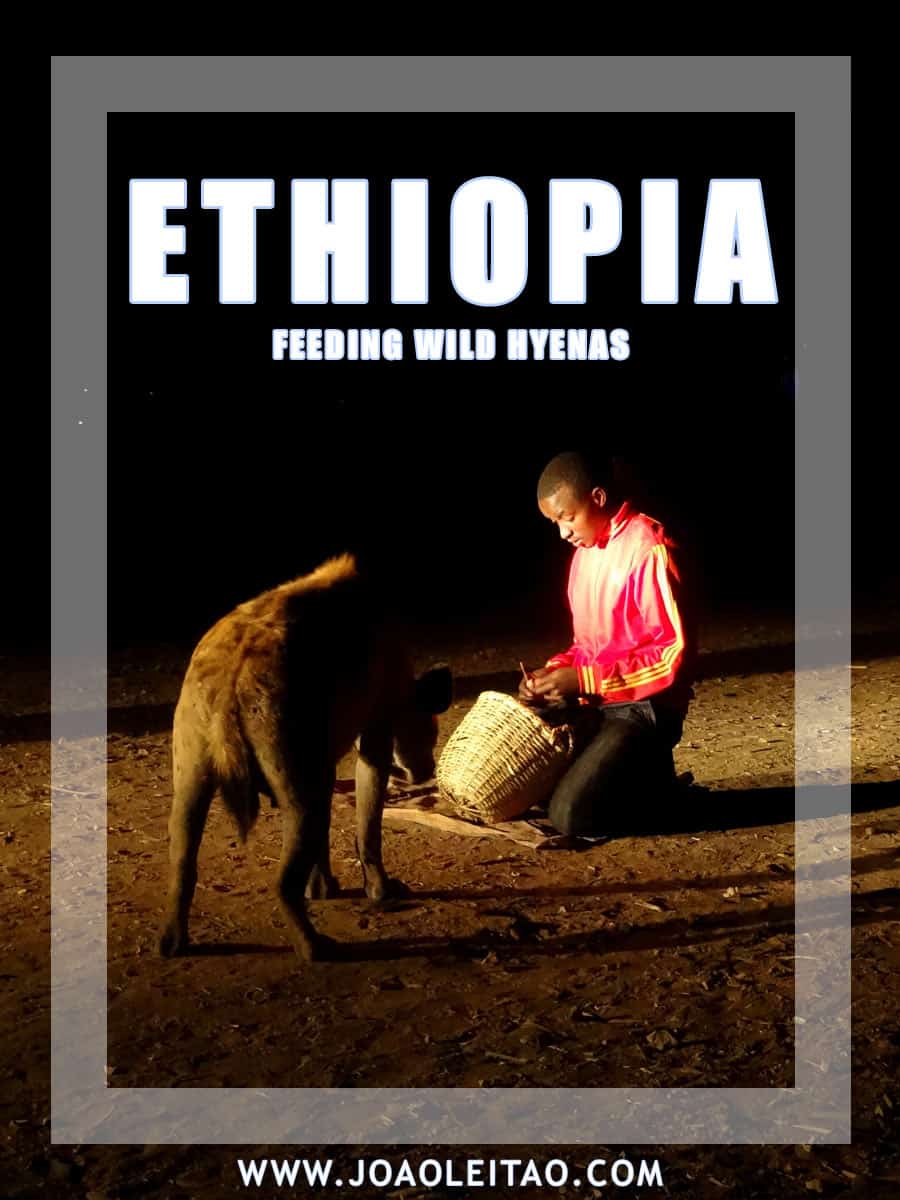
At first there were no animals, only people waiting and the hyena feeder preparing the food.

Then he started calling them.

That was one of the strangest parts.

He called into the darkness and, after some time, shapes began appearing.

One hyena came closer.

Then others.

They did not behave around us the way they behaved around him.

They were cautious with everyone else.

With the feeder there was some kind of established understanding.

They came from the darkness, ate and eventually disappeared back into it.

I would not call them tame.

They weren't.

But they knew this man.

He called them and they responded.

Watching that relationship was probably more interesting than feeding them myself.

What people in Harar told me

Before going out there, and again while talking with people around Harar, I heard many stories about why the hyenas mattered.

People spoke about djinn, spirits associated with the invisible world, and about a connection between those spirits and the hyenas living around the city.

I was also told that feeding the animals helped keep a kind of balance between them and the people of Harar.

One belief explained to me was that if the hyenas stopped coming for their food, something bad might happen.

I also heard stories connecting hyenas with protection against harmful spirits, and of people coming to Harar because of those beliefs.

These were not things I invented afterward to make the encounter sound mystical.

This was what people there told me.

And after sunset, standing outside the city while hyenas appeared out of complete darkness when a man called them, it was easy to understand why so many stories had grown around these animals.

The hyena feeder

The feeder was the person standing between our world and theirs.

I watched carefully how the hyenas reacted to him.

They recognised him.

He called them.

They came toward him.

He could be close to them in a way that nobody else there could naturally be.

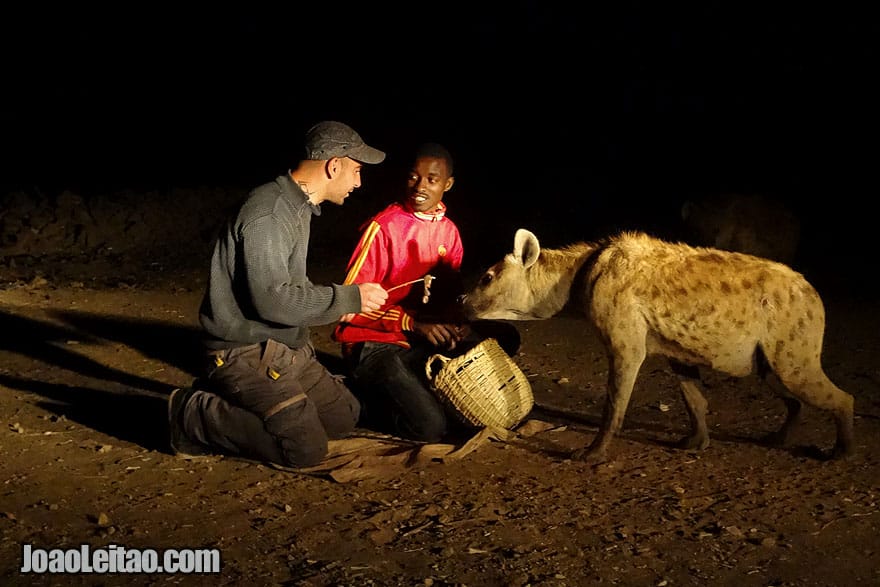
João Leitão holding a feeding stick in his mouth as a wild spotted hyena takes the meat, with the hyena feeder of Harar kneeling beside him in a red jacket
Taking my turn with the feeding stick — the hyena man of Harar at my side

That distinction is important.

It wasn't that the hyenas were suddenly comfortable with humans.

They seemed comfortable with him.

Everyone else was entering a relationship that he had already established.

He controlled the rhythm.

Wait.

Call.

Feed.

Let the animal move back.

Call again.

The hyenas could disappear into the darkness almost instantly and then return when he called.

Inches from my face

Eventually I was invited into the feeding.

I knelt beside him.

The hyena came closer.

From a distance, hyenas can look almost strange in their proportions. They have huge shoulders, a sloping back, long front legs and an enormous head.

At this distance, none of that looked strange.

It looked powerful.

I could see the coarse hair.

I could watch the ears moving.

I could hear the breathing.

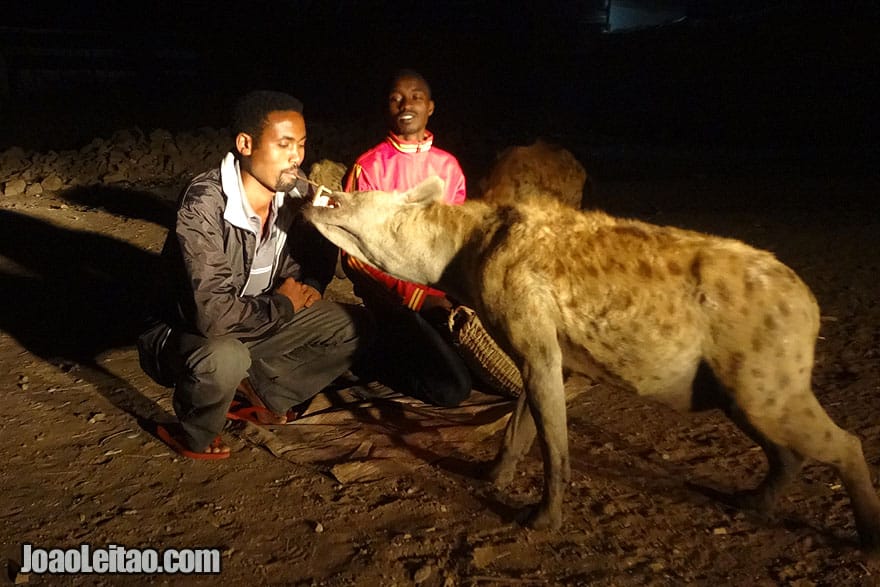
Then the animal's head came beside mine.

A large wild spotted hyena with its muzzle centimetres from João Leitão's face at night in Harar, the feeder steadying it from behind
Centimetres from my face — the moment I heard the jaws close beside my ear

The smell was what surprised me.

Its breath was right there.

Warm animal breath, strong enough that I could smell it immediately.

Then came the sound of the jaws closing close to my ear.

Clank.

I wasn't thinking that I was going to lose my ear.

It wasn't panic.

It was the intensity of suddenly experiencing this animal through smell, sound and physical distance instead of simply watching it.

A hyena was eating centimetres from my head.

There was no screen between us.

No vehicle.

Nothing.

That was the moment I remember.

Seeing the animal properly

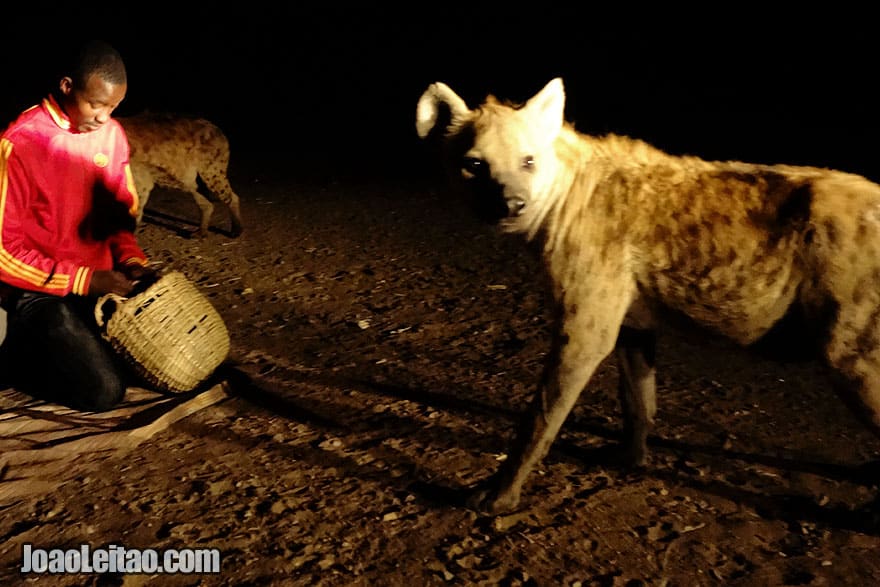
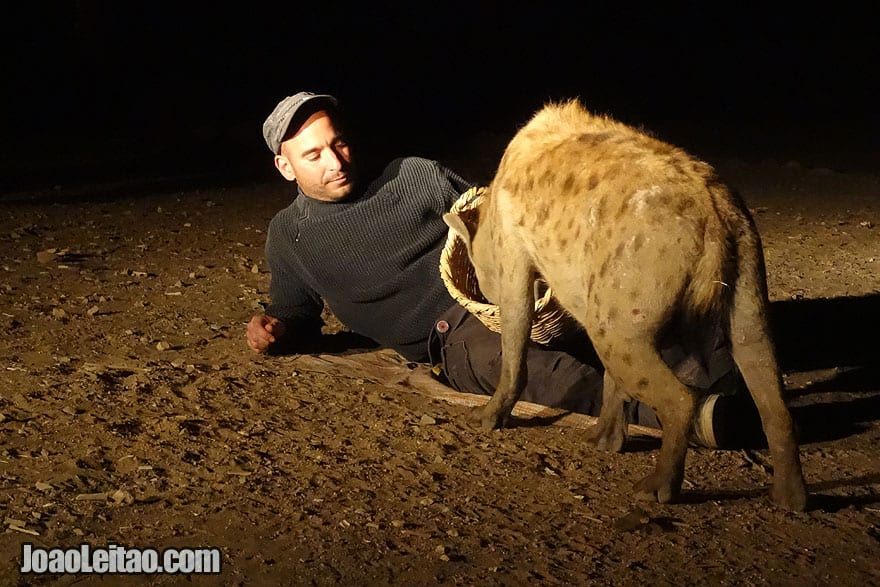
Later, one of the hyenas put its head directly into the woven basket containing the meat.

That gave me a better idea of its size.

A spotted hyena with its whole head inside the woven meat basket while João Leitão kneels beside it at the feeding place near Harar
Head inside the meat basket — the size of the animal suddenly obvious

The shoulders were massive.

The neck was thick.

Its spotted coat looked rough under the artificial light.

When the head disappeared into the basket, all the stories about spirits temporarily disappeared as well.

Here was an animal eating because food was available.

That was what made Harar so interesting to me.

Both things existed at once.

There was a real wild animal looking for meat.

And there was a human community that had spent generations building beliefs, stories and practices around living beside those animals.

You could separate those things intellectually.

Standing there at night, they felt much more mixed together.

Hearing them around Harar

The hyenas did not belong to the feeding place.

They belonged to the landscape around the city.

At night I could hear their strange calls in the distance around Harar.

Sometimes they sounded like laughter.

Sometimes howling.

Sometimes it was difficult to tell exactly where the sound was coming from.

The narrow streets and darkness gave those noises a completely different character from seeing a hyena in daylight.

During the day, Harar was busy with people.

At night, you knew the hyenas were moving somewhere around you.

What stayed with me

The woman at the guesthouse had simply told me to go and see them.

I am glad I listened to her.

Years later, I don't remember exactly how many hyenas came that evening.

I remember the feeder calling into the darkness.

I remember how the animals responded to him but remained cautious around everybody else.

I remember watching one disappear almost completely inside the meat basket.

And I remember the one beside my face.

Not because I was scared.

Because I could smell its breath.

Then I heard those jaws close beside my ear.

Clank.

A few moments later, the hyena walked back into the darkness.

Continue to my Ethiopia travel page for more stories from Harar and the rest of the country.

Small-group expeditions

Travel the unexpected with me.

Ethiopia, the Sahara, Afghanistan — I lead small-group expeditions to the places most people only read about, with guaranteed departures.

Explore group tours →

More stories