
I arrived at Palmyra expecting almost everything to be destroyed.
Years of photographs from the war had reduced the place in my head to explosions, collapsed temples and broken columns. I knew what had happened there. I expected to arrive at something resembling the remains of a destroyed archaeological site.
Then I started walking.
Palmyra was enormous.
Yes, some very important monuments had been destroyed or badly damaged. You could see that immediately.
But most of what surrounded me was still there.
Columns continued into the distance. Temple structures remained standing. Carved blocks lay everywhere. Streets and monumental buildings could still be followed across an archaeological landscape much larger than I had imagined.
What I had got wrong was the scale.
I had been thinking about the destroyed monuments. Palmyra isn't one monument. It is an ancient city.
That became one of the surprises of visiting Syria's UNESCO sites myself.
Across trips in 2020, 2023 and 2025, I eventually reached all six World Heritage properties in the country.
I still can't choose the best one.
Story Notes
- Visits
- Three journeys — 2020, 2023 and 2025
- The list
- Six inscribed World Heritage properties, all currently on UNESCO's List of World Heritage in Danger
- One detail
- Crac des Chevaliers and Qal'at Salah El-Din count as a single property — two very different castles
- The last one
- The Ancient Villages of Northern Syria, finally reached in 2025 after ~14 years when the region was effectively out of reach
Syria's six UNESCO World Heritage Sites
The complete list is:
- Ancient City of Aleppo
- Ancient City of Bosra
- Ancient City of Damascus
- Ancient Villages of Northern Syria
- Crac des Chevaliers and Qal'at Salah El-Din
- Site of Palmyra
There is an important detail in that list. Crac des Chevaliers and Qal'at Salah El-Din count as one UNESCO property, even though they are two completely different castles in different locations.
And the Ancient Villages are not one village. The UNESCO property consists of dozens of settlements grouped into eight archaeological parks across northwestern Syria.
I wanted to see all of it.
Palmyra was much bigger than the destruction
Palmyra was probably my biggest mistake before arriving.
I thought too much would be gone.
The reality was more complicated.
Some of its most famous monuments had indeed been deliberately destroyed during the war. But the archaeological city spreads across such a huge area that losing several extraordinary buildings did not mean losing Palmyra itself.
Walking through it made that obvious.
There are enormous quantities of carved stone lying everywhere. Columns still stand in lines. Doorways rise above you with almost nothing around them. Behind everything is the Syrian desert.
Palmyra grew at a meeting point between different worlds, and you can read that mixture in its architecture. Roman forms are everywhere, but this never looked to me like simply another Roman city transplanted into Syria.
It belongs to the desert.
That landscape is part of it.
At the time of my visit there was also a Russian military presence around the Palmyra area. After everything that had happened there, travelling around such a famous archaeological site with military forces nearby was another reminder that I was seeing it during a very particular period of Syrian history.
Still, what remains strongest in my memory isn't the soldiers.
It is the size of the ruins.
Damascus was alive
Damascus was almost the opposite experience.
I wasn't walking through an empty archaeological zone.
I was walking through a city.
Old houses lean over narrow streets. Metal shop shutters open directly onto lanes barely wide enough for a car. Arabic writing covers walls. People walk home, go shopping, meet friends and eat.
Compared with the destruction I had seen elsewhere in Syria, the Damascus I walked through felt remarkably intact.
And it was alive at night.
Restaurants.
Food.
Markets.
People in the streets.
Tea.
Traffic.
Noise.
The UNESCO property here isn't an isolated monument behind a ticket office. It is the historic city itself. The Umayyad Mosque, old houses, markets, religious buildings and the street network all sit inside a city people are still using every day.
That makes Damascus completely different from Palmyra.
One is an archaeological city in the desert.
The other doesn't let you forget for five minutes that people still live there.
Aleppo and the Citadel
Aleppo gives you another version again.
The entrance to the Citadel is huge.
You approach it across stone and climb towards a fortified gateway that seems to occupy the entire frame in front of you. The stone walls carry repairs, changes and additions made through different periods.
Aleppo itself has thousands of years of layers.
The Citadel is only one element of the UNESCO property, together with the historic streets, mosques, madrasas, khans, hammams and other buildings of the old city.
But visually it dominates everything.
After photographing damaged places elsewhere in Syria, standing inside something this massive was another reminder that destruction is never uniform. One street can be badly damaged while another historic structure remains standing.
Bosra from inside the theatre
Bosra was different again.
The Roman theatre is the obvious reason.
I climbed high enough into the structure that I could look down over the semicircular seating and towards the stage.
The theatre is unusual because later fortifications effectively wrapped around it. What began as a Roman performance space eventually became part of a fortified complex.
You can feel that when you're inside.
It doesn't resemble an isolated classical theatre exposed on an open archaeological plain. High stone walls contain it.
Bosra also had a completely different political atmosphere when I visited.
The south of Syria had gone through its own Russian-mediated reconciliation arrangement after years under opposition control. Former local opposition fighters remained influential in the area, so the security situation around Bosra did not feel identical to other government-controlled parts of the country.
But once inside the theatre, the thing I remember is stone.
Huge quantities of it.
Seats climbing above me and that monumental stage architecture across the other side.
Qal'at Salah El-Din
Then there was Qal'at Salah El-Din.
Just impressive.
What surprised me here was the landscape.
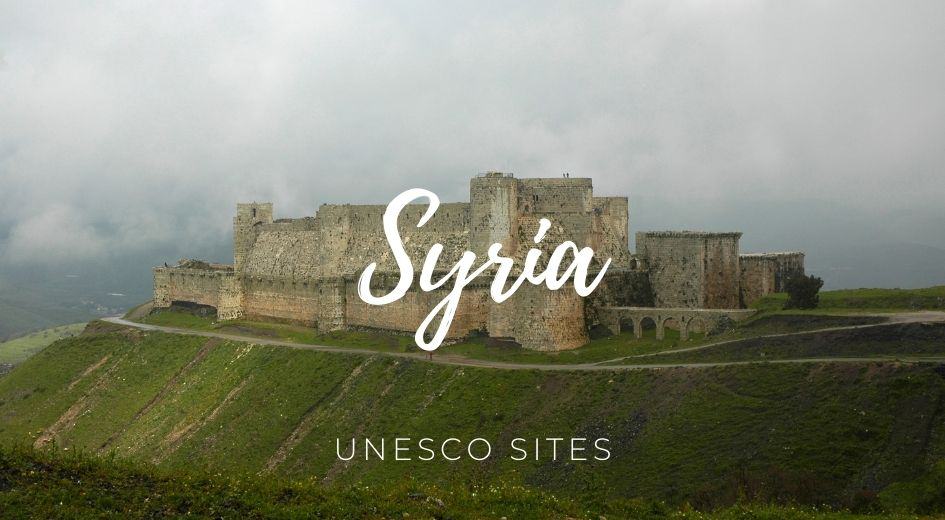
You could show somebody photographs of Qal'at Salah El-Din and Crac des Chevaliers without telling them that UNESCO treats the two castles as one property, and I don't think most people would connect them.
Crac rises like an enormous stone machine above open hills.
Qal'at Salah El-Din sits among deep green valleys.
The fortress occupies a rocky position where the terrain itself forms part of its defence. Walls and towers combine with cliffs and the surrounding landscape.
UNESCO put the two castles together because they show different stages and influences in the development of fortified architecture in this part of the Middle East.
From the visitor's point of view, they simply feel completely different.
Crac des Chevaliers with nobody there
I visited Crac des Chevaliers in 2023.
Almost no tourists.
It is difficult to understand the size of Crac until you see the whole thing from outside.
Walls behind walls.
Round towers.
An inner fortress protected by another defensive system.
Then you enter and everything becomes passages, vaulted rooms, courtyards and enormous blocks of stone.
There was still visible war damage.
Around the chapel I saw a damaged section that I understood had been hit during the fighting. At the same time, restoration was underway.
A Syrian-Hungarian archaeological project involving specialists from Pázmány Péter Catholic University in Hungary had already been working at the castle, including in the church area, and Hungarian-supported conservation continued after the 2023 earthquake.
So inside one building I could see several periods at once.
Crusader stonework.
Later modifications.
War damage.
Modern repairs.
And almost nobody visiting.
Fourteen years later: the Ancient Villages
The last part of the UNESCO list that I really wanted to reach was in northwestern Syria.
In 2025, I finally went.
For roughly fourteen years after the conflict began in 2011, this part of Syria had been caught inside some of the country's most complicated front lines and political divisions. International tourism had essentially disappeared from many of these areas.
The UNESCO name is Ancient Villages of Northern Syria.
People also commonly call them the Dead Cities.
That name can be misleading because you're not visiting one abandoned city.
The UNESCO property covers around forty ancient villages grouped in eight archaeological parks across the limestone hills of northwestern Syria.
I made the effort to reach Qalb Lozeh.
The church is the thing you immediately notice.
Huge stone arches open the interior rather than dividing it into tight rows of columns. Decorative bands run around doorways and arches. Even with sections missing, there is enough standing to understand the proportions of the building.
This countryside once contained prosperous rural settlements rather than great imperial capitals. Houses, churches, cisterns, baths, agricultural installations and stone field systems survive across the hills.
That is what makes these places unusual.
It isn't Palmyra.
There isn't one monumental avenue telling you where to look.
You have to walk.
Kirkbizeh
I also visited Kirkbizeh.
You will also find it transliterated as Qirqbize, Kirkbize or Qarqbizeh.
Kirkbizeh is especially interesting because the remains include an extremely early Christian worship building, from the period when the architecture of churches was still developing out of much simpler domestic forms.
It is exactly the kind of place that can disappear beside Syria's much more famous monuments.
Palmyra gives you gigantic columns.
Crac gives you walls.
Bosra gives you one of the great surviving theatres.
At Kirkbizeh, you have to know what you're looking at.
I still can't choose one
After visiting all six, I can't make a convincing ranking.
Palmyra has the scale.
Bosra has the theatre.
Crac des Chevaliers has the fortress architecture.
Qal'at Salah El-Din has the setting.
Aleppo has the Citadel and the old city around it.
Damascus has something the archaeological sites can't have: daily life continuing inside the World Heritage property.
And the Ancient Villages took me somewhere I had been unable to reach for years.
If I had to keep one image from the whole project, I still wouldn't know which one.
Maybe that is the answer.
There isn't one Syria UNESCO site. There are six completely different reasons to cross the country.
Syria UNESCO Tentative List
Syria currently also has 12 properties on its UNESCO Tentative List:
- Noréas de Hama
- Ugarit (Tell Shamra)
- Ebla (Tell Mardikh)
- Mari (Tell Hariri)
- Dura Europos
- Apamée (Afamia)
- Un Château du désert : Qasr al-Hayr ach-Charqi
- Maaloula
- Tartus : la cité-citadelle des Croisés
- Raqqa-Ráfiqa : la cité abbasside
- L'île d'Arwad
- Mari & Europos-Dura sites of Euphrates Valley
For more of the places I reached on these journeys, read the story of crossing Idlib and the M5 during the war — or continue through my best travel experiences.


